“Case
in point: I have hardly left my room this week after the latest weekend, not
due to tiredness, but due to interrogating what’s important.” And what’s
important was to keep the band wagon rolling, this weekend was spent in Kyoto
bounding through temples, bars, shops, trains and mountains.
The
team consisted of Koike san (my associate professor), Sakane San (a friend and colleague
from The University of Tokyo), Bojan and myself. The main purpose again was to visit Katsura
imperial villa to assist Bojan in capturing footage for his PHD. Koike San was
down visiting a clients of hers with her adorable daughter and Sakane San
decided to come along for a break from Tokyo town. I was particularly keen to capture the first
frames with my recently acquired vintage Hasselblad camera. As much as I love
instagram and its revitalized concept of the Polaroid “snap”, I feel it
necessary to have some “keepers” so to speak of this perplexing country in
which I call home. The Japanese analog culture has further captivated me -
firstly through the rich LP culture but film photography is still alive and
well also. Both of these mediums of art and creation embody tactile qualities.
It is this tactility and notion of primitiveness that captivates and engages many.
What is more, the architectural projects in which I admire echo these qualities
and incorporate simple methods in the design process. In this light, it is
clear that I find disparities of vernacular architecture, art and music the
upmost inspiring. See Peter Rich,
mapungubwe interpretation centre, South Africa and listen Aster Aweke - Y'shebellu

So
it was Friday night and I head to Shinjuku station to meet up with Bojan and
Sakane san. They were both fashionably 20 minutes late but it didn’t matter all
that much. We bought our tickets, hung around and boarded our double decker JR night
bus. Koike is already in Kyoto at this point. The seats were comfortable with
generous legroom however the lower level in which we sat was quite claustrophobic
due to the extremely low ceiling height. Nonetheless, still not as threatening
as the rusty crustys of India and Nepal. I listened to some music and then
dozed off. We all woke when we arrived in Kyoto at around 6:30am. We gathered our bags and thoughts, rubbed our
eyes, ruffled our hair and slumped outside McDonalds waiting for it to open and
provide us with much needed refreshments and junk food. Once inside, we
collected our orders and descended into the underground seating area. The seats
were finished in the reflective glitter PVC you see in Grease, and the two
party girls passed out the bench where dressed equally as glittery. I fiddled
around with my camera and loaded my first roll of film. I am excited. Koike
calls and she is up and about, requesting us to make our way to Byodo-in 40
minutes away by train. So we roll out.
After
a pleasant journey from Kyoto station to JR Uji Station on the JR Nara Line,
we met up with the smiling and fresh Koike San at the entrance. Byodoin Temple is a striking example
of Buddhist Pure Land architecture. Together with
its garden, the temple represents the Pure Land
Paradise. Originally it was a countryside retreat villa for the powerful
politician Fujiwara no Michinaga, but was later turned into a temple by
his son through the construction of the Pheonix Hall. Currently, it’s presence
on the Japanese 10 yen coin owes to its popularity. We took a guided tour of
the Pheonix hall and visited the recently constructed museum. Fujiwara no Michinaga
After Byodoin we strolled along the Uji
River and made our way to what claims to be the oldest shrine in all of Japan,
Ujigami Shrine. The honden of the
Ujigami Shrine is known as the oldest example of nagare-zukuri style of shrine architecture in Japan.
The haiden is built in the shinden-zukuri style, and its roof in the sugaruhafu style. The roof entails very charming
curved eaves on the opposing east and west facades.
From here
we took short stroll back across the river and popped into at eirakuya R A A K
(http://www.eirakuya.jp/). Each of
us picked out a dyed towel, casually left and headed up the road for a delicious green tea soba and
desert lunch inside an original bourgeois residential property of the Edo
period. From here we made our way back to Kyoto station by train and then took
a taxi to Katsura Rikyu. This particular visit revealed the garden at its most
lush. The increased heat and occasional torrential rain has the trees and
shrubs bursting with growth and aroma. I was concentrating on the recording and
photographic process, however thinking two dimensionally gave me a fresh
perspective on how one experiences and views particular moments of the villa.
eg. The variations of depth of field and the layering of vistas.
After the tour we made a quick dash in
taxi to Sanjosangendo Temple. The taxi driver made the journey very
entertaining both through his spirited driving (we were running out of time)
and his bafflement over the geographical position of Serbia. Quite the
character. Despite the excitement, we made it just in time. Sanjosangendo is a
Buddhist temple whose name literally
means Hall with thirty three
spaces between columns, describing
the architecture of the long main hall of the temple. Inside exists one
thousand spectacular life sized statues of the Thousand Armed Kannon.
Once leaving Sanjosangendo, Koike san
invited us to her clients home. Nestled at the foothills on a dramatically
sloped sire in the North western mountains of Kyoto, the black timber home sits
stoic and contentedly. The family of four inside the lit enclosure looks out towards
the street as we arrive and wave uncontrollably. We exchange greetings and then
proceed on an inquisitive question and answer critique of the house, circumnavigating
around the entire structure. We stood out the back slope talking about the wild
deer that come and eat their plants and the construction materials all the
while the children wandered off into the forest with their pet cat. What a
magical place for a child.
The house is relentlessly black, clad in
a fired cedar pine and accompanied by black window frames, eaves and protruding
rafters. The aesthetic is stark but soft and the form is crisp and essential.
Topped by a thin gabled roof, the simple rectangular wooden box is punctured by
small openings where needed to allow the entrance of light and air. A large
opening on the East face opens out to a timber veranda which offers panoramic
views of the nearby mountains and distant city landscape. Upon entering, one is
met with an evident sense of warmth and homeliness. The décor echo’s a retro
70’s influence through the Danish furniture, cork flooring and low lying
horizontal dimensions of the joinery.
The plan is open and efficient, with storage space is incorporated into
the unorthodox spaces created by the slope of the land. There are no walkways
or halls, allowing every square meter to be used and adapted to a range of activities.
The two you daughter’s bedroom is shared, however the use of twin access allows
for separation in their later years. Pivot openings above the bedroom doors
allows maintained privacy and cross ventilation. This is a fine family home in
a wonderful part of the world.
After the tour of the house, which
included mulling over the drawings and material samples, we were treated to tea
and cake. The evening was fast approaching and I needed to get to check into my
hostel and Bojan and Sakane san had a train to catch back to Tokyo. The owner
kindly drove us back into town, which made me realise it was the first time I
had been in a car besides a taxi since leaving home (it’s a big deal for a
suburban Australian). We had half an hour to spare so we quickly scoffed down
delicious okonomiyaki (Japanese
savory pancake) in Gion.
To no surprise, Bojan bailed in his
plans to rush back to Tokyo and decided to stay the night in Kyoto. So we both
trotted off towards our hostel named Pan & Circus. Now, Pan & Circus is
not your usual hostel arrangement, especially for Japanese hospitality
standards, but what it has in droves is character. Located only 10 minutes on
foot from downtown, the hostel is subsidiary to its street front bar. In the
dark street we saw a venue buzzing with light and activity, “that’s it!” I said
and both Bojan and I were aghast. Inside an art installation opening party was
playing out so we shuffled through the people and made our way to the bar to
say, “Uhhh…we have a reservation”. The
delightful bartender pointed us in the direction a rusty and haggard door. Pan
& Circus is housed in a machiya style town house served as a former pawn
shop, so fittingly the décor of both the bar and upstairs sleeping quarters is
an eclectic mix of antiquities: furniture, paintings, books, rugs, mirrors,
musical instruments and bits and bobs. It is a feast for the eyes as the
designs undercurrent is a fusion of baroque and bohemian flavors. We made our
way up the creaky and narrow stairwells past the charming second floor communal
space to the third floor roof space. Here, two bunk beds, a couple of futons
and a hammock fill a spartan tatami room guttered of its shoji screens. The
windows were covered in plastic offering precarious privacy but the original
open ceiling and atmosphere of the room was so cool I couldn’t care less. The
cooking facilities are located back down on the ground floor in which you have
to pass through and a decrepit alfresco passage to reach the frugal shower. To top
it off, the place was run by a bubbly bunch of young locals and its cheap (2500
yen per night)
We got settled and headed out for a late evening of meeting people, eating, drinking, dancing and arm wrestling. Just the usual. I made it back to Pan & Circus at respectable hour…sort of. Bojan followed an hour or so later.




We woke up at around 11am with no real strong intentions for the day despite getting a bus ticket for Bojan to return home. Oddly, the hostel was oddly abandoned so I roamed around and took a few photographs. We tentatively left, locked the door and slowly walked towards Kyoto station stopping off to consume bananas and orange juice. Once at Kyoto station Bojan bought a ticket and we then consumed more food before deciding to head to Arashiyama for the afternoon. So we boarded the train along with a bunch of adorable elderly locals who were fascinated by us and enjoyed the journey to Arashiyama. Once there, we purchased tickets for the “Romantic Sagano Train” and watched a small festival parade go by. We had an hour or so to kill so we decided to just chill out a local café / designed objects shop. We each had a coffee and controlled our gluttonous impulses by sharing a banana and chocolate pancake.
The Sagano Romantic Train is 25 minute
train ride that follows the course of the Hozu River
on a narrow-gauge track through the idyllic canyon from Arashiyama to the rice
agricultural fields of Kamoeka. It was loud, exciting, beautiful and well worth
it. I particularly enjoyed the way in which it drops you off literally in the
middle of nowhere with the idea being you take it to return or connect to the
JR train a five minute walk away. We opted for the latter. Before we boarded
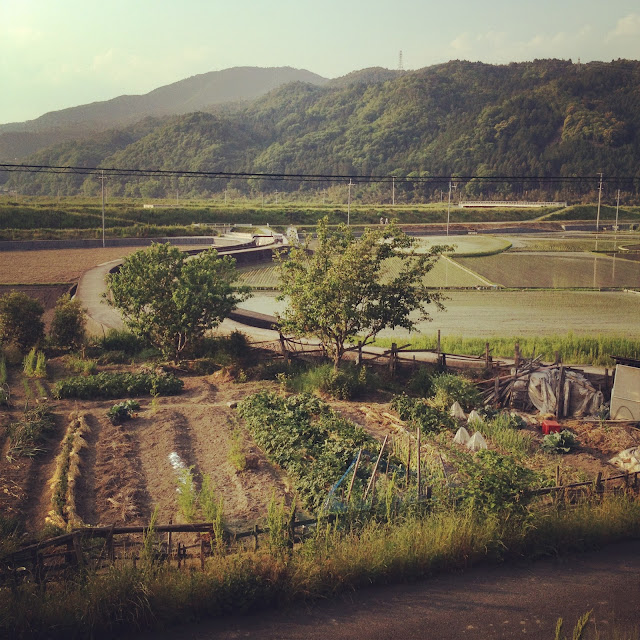
the train however, we decided to enjoy the symptomatic scenery of the Kamoeka
Area. In the foreground, rice paddies glisten in the afternoon sun while their
owners meticulously attended the adjacent vegetable gardens. In the middle
distance lay rows of houses foregrounded by a train line, and behind them,
housing towers reach far into the sky. A flared haze of a dramatic mountainous
ridgeline marks the outermost boundary of the scene.
After taking a couple of
photos, we stopped by to chat to a local man named Go: “my name is Go…easy come easy Go” is what he
hilariously stated. We inquired about the rafting activities in the Hozu river
and he enthusiastically told us about his trip to the Philippines. It was a
brief but colorful encounter. We found the station after Bojan asked some stray
children on the street where it was. I thought it wasn’t best that two big
hairy Gaijins in the middle of nowhere approach small children playing the
street, however despite my assumption they came running up with attentive
excitement and performed and synchronized salute in the direction of the
station. We boarded the train and headed back to wander through the famous
Arashiyama bamboo grove. After meeting a
few Tokyoites in the grove and enjoying the setting sun we eventually made it
back to downtown Kyoto by train. Once there, we dropped into Jetset records to
wreak some more financial havoc for the greater good of AfroBeat and Ethiopian
Jazz music. An Udon noodle dinner followed to replenish our tiring bodies. During
dinner the beautiful Jamila, a friend of ours, paid us a visit. The three of
strolled through the evening in Pontocho before setting up camp along the Kamo
River. We retired there for an hour or so enjoying each other’s company and
staring into the trickling river water.
Not before long we took a
taxi and we parted ways at Kyoto station to board our respective buses bound
for Tokyo.
What a brilliant and
gratifying couple of days.